I supported universal health care for twenty years for the wrong reason. It took this administration dismantling the instruments to show me what the right one was.
Let me start with a confession, because I think it explains why we have lost this argument for thirty years.
I have always been a supporter of universal health care. But if I am being honest with you, I saw it as a benevolence. As a good physician, as a good Christian, as a good person — of course I wanted the poor to be cared for. Of course I wanted the single mother to be able to see a doctor. Of course I wanted people to be healthy. I filed the whole question under I want to be a good person, and I left it there.
That argument is weak.
Not wrong. Weak. Because it depends entirely on the listener wanting the same thing you want. And we live in a society where a great many people, including many with the power to decide, are not especially interested in being good. If your case rests on their goodness, you have handed them the veto. I think that single move has handicapped the conversation about health care in this country more than any policy detail ever has.
I would probably never have challenged that perspective. I was comfortable in it. What forced my hand was this administration.
I can talk for a very long time about what has been done to women over the last two years. But most of it has been said already, and the people who disagree with me would like nothing more than to file my whole argument under woke bullshit — so I will keep it concrete.
The Pregnancy Risk Assessment Monitoring System — PRAMS, the survey that has told us for four decades what actually happens to women around childbirth — had its collection halted in January 2025, mid-collection. The AHRQ discharge databases, the backbone of hospital-level outcomes research, are in play in the 2026 bill.
In April 2025 the majority of the staff at CDC's Division of Reproductive Health were let go, the entire PRAMS team among them. The Office of Minority Health was eliminated twice over — once at HHS, once at CMS. On March 31, 2025, sixteen Title X grantees were told their money was being withheld: twenty-two grants, nearly a quarter of the eighty-six service grants awarded that year, including all thirteen direct awards to Planned Parenthood affiliates. Guttmacher's estimate is that at least 834,000 people lose Title X care over the course of a year — thirty percent of everyone the program serves. Seven states lose it outright. Fifteen more lose part of it.
Work that took generations to build is disintegrating in front of us.
But whether or not we have the information does not change our duty to care for patients. So we started asking a different question:
Is there a way to know something when the people in power would rather you didn't?
Hold on to that. I am going to leave it there for a few minutes.
Forgive me a divergence
For those of you who know me, you know I write fiction. I love a story. People who read pitch decks for a living tend to start checking their phones when I do this. But this is the benefit of writing on your own platform: sometimes you get to say the thing the way you actually want to say it.
So I want to take you back to 2006.
In 2006, national home prices in the United States peaked. Almost nobody experienced that as an event. Housing had gone up for a decade. The instruments built on top of it were rated as safe as government debt. The people whose job it was to see risk were, by and large, looking at the same numbers as everybody else and reaching the same comfortable conclusion.
But not everybody.
A year earlier, in August 2005, an economist named Raghuram Rajan stood up at Jackson Hole — the annual gathering of the people who run the world's central banks, at Alan Greenspan's farewell symposium — and argued that financial innovation had quietly made the system more fragile, not less. He was, more or less, laughed out of the room. Larry Summers called the argument misguided. It was not a popular thing to say to that audience on that day.
By early 2007, subprime lenders were failing. New Century, one of the largest, filed for bankruptcy in April. By the summer, two Bear Stearns funds had collapsed. By September 2008, we were somewhere else entirely.
Here is the part I want you to sit with. Rajan did not have secret information. Neither did the handful of investors who made the other side of that trade. The loan tapes were public. The delinquency rates were public. The ratings methodologies were published. Everything necessary to see it was sitting in the open, in ledgers kept by people who had no interest in warning anybody.
So you are probably wondering what the 2008 financial crisis has to do with maternal mortality.
Rarely do real crises happen with nobody knowing we are on the precipice. It happened with the dot-com valuations. It happened with COVID — people had been talking about pandemic preparedness for decades. It is happening right now with AI, with the circular financing and the fantasy of instant workforce transformation.
Before every crash there are people who see before it is obvious. Who see before the seeing. Who know before the knowing. They are not smarter and they do not have secret information. Everything they needed was public. They were simply reading a different set of books.
And right now we are inside one of those cycles, in the birthing world.
The crash is coming. Every piece of data we have points at a catastrophe at scale, and it will not be measured in write-downs.
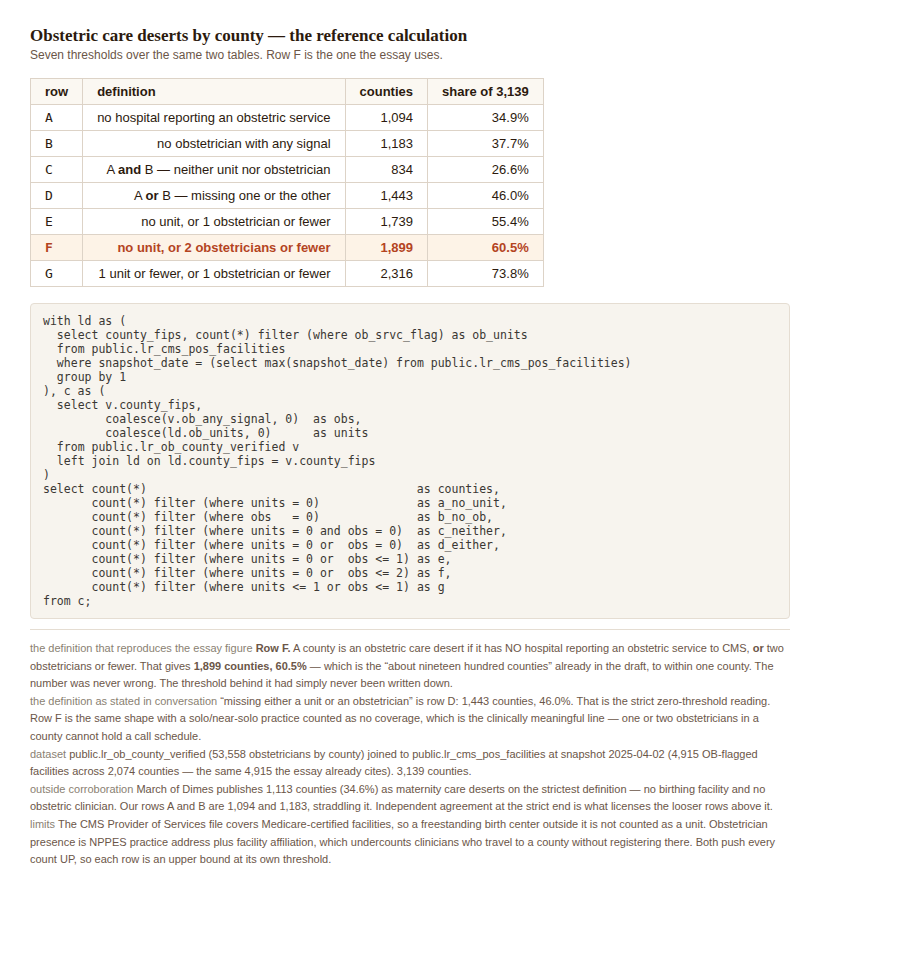
Five things are arriving at once. 508 hospitals have stopped delivering babies since 2011, leaving about nineteen hundred counties — roughly two-thirds of the country — as obstetric care deserts. The federal projection has one in ten obstetrician-gynecologists gone by 2037, and rural supply meeting barely half the need. The preterm birth rate has gone from 9.84% to 10.39% while total births fell 8% — the denominator dropped and the numerator did not follow. NICU cases are getting sicker and cost more: admissions of extremely, very and late preterm infants up 10 to 18%, infants with a complex chronic condition up from 46.6% to 50.9%, and median cost per case up about 20%, inflecting in 2020 and 2021. And Medicaid pays fifty cents on the dollar.
That last one deserves its own paragraph, because it is the one everybody has agreed to misunderstand.
Medicaid pays about fifty cents on the dollar. Not across the whole program — on the thing we are talking about, which is managing a birth. It is the payer for 41% of American births and 47% of births in rural areas. In Louisiana it is close to seven in ten. And it pays roughly half of what that care costs to provide.
And it is being gutted. Almost a trillion dollars is coming out of Medicaid under Trump's and the Republican Party's Big Beautiful Bill. The Congressional Budget Office scored that bill: the poorest tenth of American households lose 3.9% of their resources, about $1,600 a year each, while the richest tenth gain about $12,000. Money is being moved upward, and the floor under American maternity care is one of the things being sold to pay for it.
We have allowed Medicaid to be described as health care for the poor. It is not. Medicaid is the floor. It is what keeps rural hospitals open. It funds the training of the next generation of physicians. It is the load-bearing wall of American health care, and most of the people standing on it have no idea they are standing on it.
And the people who benefit from calling it health care for the poor are the same people who benefit from the financialization of health care. That framing is not an accident and it is not innocent. It is what makes a trillion-dollar cut sound like a budget adjustment instead of what it actually is — pulling the floor out from under everyone.
We have an aging workforce, a shrinking safety net, patients who are older and sicker and having children later, and an administration that took a sledgehammer to the health care system.
Who holds the risk
So — back to the question I left with you.
Is there a way to know something when the people in power would rather you didn't?
A maternal death is not a quiet event. It is so catastrophic, so expensive, so legally consequential that it leaves marks in a dozen ledgers that have nothing to do with public health. Insurers have to price it. Public companies have to disclose it. Courts have to docket it. And hospitals — every hospital — have to file a cost report with the federal government whether they want to or not.
You can turn off the measurement. You can turn off the science. You cannot turn off the money. There are forces in this country more powerful than the government, and they will not permit the money to be turned off.
So we followed the financial signals, and they led somewhere I had never thought to look.
What happened in 1990
I am almost embarrassed I did not ask this sooner, because the question is simple: what happened at the inflection point?
It is not as though America was always like this. We used to improve alongside the rest of the world. Then, around 1990, our line turned and theirs did not. Between 1990 and 2015 the global maternal mortality ratio fell over 40%. Ours went the other way and has been going the other way ever since.

The story right now is systemic racism in medicine driving bad maternal outcomes. That story is true. What is not in the story is that three decades ago we were better than this.
Why?
Where race fits
The conversation about maternal health in this country has centered on Black maternal mortality, and for good reason.
In 2021 this country recorded 32.9 maternal deaths per 100,000 live births. For Black women it was 69.9.
Then the national number improved — 22.3 in 2022, 18.6 in 2023. The number for Black women went to 49.5, and then back up to 50.3. The country got better. They did not. By 2023 a Black woman was dying in childbirth at nearly three times the national rate, and the gap widened in the year everybody else was writing good news.

And Black women do not have the worst rate in America. American Indian and Alaska Native women do — in 2021, 118.7 pregnancy-related deaths per 100,000, nearly five times the rate for white women, the highest of any group in the country.
CDC has had to build a separate method for finding Native people in this data, because the ordinary one loses them: deaths recorded under another race, or under Hispanic origin, dropping out of the count entirely. The worst death rate in America belongs to the population we are least able to count. Whatever the true number is, it is worse than the worst one we publish.
And none of it is an act of God. Physicians reviewed these deaths one chart at a time, across 36 states: 84% were preventable. Among Native women, 93%.
You do not judge a health care system by how well the best-off do inside it. You judge it by the bottom. That is the only honest assessment, and I stand by that as a physician.
I take the arguments about systemic racism in medicine extremely seriously. I agree with them. I have been making them for years. But they do not explain the data.
We were not less racist in 1989 than we were in 1991. None of the things I have heard offered explain what happened in 1990.
We were right about where the harm lands. We were right that it is designed. And that righteous focus — mine included — is exactly what kept us from seeing the bigger story. We were looking hard in one place and blind in another.
So we built our own instrument. Fifteen annual snapshots of every hospital in the country, provider by provider. Federal cost reports. Licensing files. SEC filings. Two years ago this would have taken a team, a grant, and an institution behind it.
I was doing it on my MacBook.
What the money says
Three things happened around 1990, and together they set the stage.
The first was the obstetric malpractice crisis. Obstetricians are among the most sued physicians in America — 63.6% have had a claim filed against them, and by 45 nearly three in four will have faced one. And you have to be honest about why those suits exist. A baby injured at birth is injured for life, the costs are enormous, and the family has nowhere else to go. The lawsuit is the protection. Most peer countries handle that same injury through no-fault compensation, so the protection does not have to be bought one physician at a time. Here it does. And the protection has a price.
Between 1982 and 1986 the mean professional liability premium for a self-employed obstetrician-gynecologist rose 171%. By 1987 the average was $37,015 a year, up from $23,256 two years earlier, and in some cities it passed $100,000. In 1988 ACOG found 12.4% of obstetricians had stopped delivering babies — in Florida, 25.1%. It never repriced back. Today an OB-GYN pays between $60,000 and $200,000 a year, premiums are still climbing 15 to 50% depending on the state, and 30% of practicing obstetricians say they will leave the field within twelve years, with the cost of insurance as the first reason they give.
So the cost of protecting the injured drives obstetricians out of catching babies, and fewer obstetricians catching babies produces more injury.
The second was Medicaid. OBRA 1989 took effect in April 1990, requiring every state Medicaid program to cover pregnancy up to 133% of the federal poverty line. More women covered — a good thing, and I would vote for it again. But Congress mandated the coverage without mandating what it paid. Medicaid reimburses roughly half the cost of a delivery. So from April 1990 the rule was that every birth to a poor woman is a transaction the hospital loses money on.
And a labor and delivery unit has a fixed cost. It runs somewhere around fifteen to twenty thousand dollars a day to keep open — the anesthesiologist, the scrub tech, the nurses, an OR held ready, the blood bank. That cost does not move with volume. It is the same whether you deliver eight babies that day or none. Which means two hospitals can carry an identical Medicaid share — the same number on both spreadsheets — and be in entirely different situations. A large system absorbs the loss across service lines. In a thirty-bed hospital, twenty thousand dollars a day against a payer reimbursing half of cost is the difference between having a delivery room and not having one.
And that was before. The Big Beautiful Bill Act is positioned to take a trillion dollars out of Medicaid. Every hospital I have just described is about to be asked to absorb more of the same loss with less.
The third came from my husband.
I showed him this graph and asked him about the data we had around private equity. Private equity in medicine is not a new story. What was new was the timeline.
He said: well, you know what happened in the eighties?
I had no idea what happened in the eighties.
Leveraged buyouts. Hostile takeovers. Sale-leasebacks. Dividend recapitalizations. These financial instruments started to get popularized across that decade, and by the 1990s they had started to make their way into medicine.
Those three set the stage. Here is what stands on it now.
Private equity buys a nonprofit hospital system. It sells the real estate out from under it to a REIT, borrows against what is left, and pays itself the proceeds. Then it hands back an operating company carrying rent it can never service. Cerberus bought Caritas Christi in 2010 for about $895 million, mortgaged and sold off the hospital real estate to Medical Properties Trust in a $1.25 billion deal in 2016, and took a $719 million dividend that same year. Then the bankruptcy. Then the delivery rooms close.
That is the part that closes a unit. And because it is a financial process, it leaves a financial trail. We mapped twelve closures backward in six-month intervals, and the same signals appear twelve to twenty-four months ahead every time: operating margins negative for years running, a credit rating parked at the bottom of the scale, vendor lawsuits stacking up, medical equipment repossessed by suppliers who stopped getting paid. In the worst cases no audited financial statements filed at all — and the opacity is itself the signal.
How far it has already gone
Once you know what the trail looks like, you can count. So we counted.
In 2011, 5,026 American hospitals reported an obstetric service. In 2025, 4,915 did. A loss of 111 — the kind of number that gets a shrug in a hearing.
Underneath it: 508 hospitals stopped delivering babies. 397 started.

Those do not cancel. A delivery room opening in a growing suburb does nothing for the county that went dark, and if you report only the net you cannot see the harm.
And this is what it adds up to on the ground: about nineteen hundred American counties — roughly two-thirds of them — are obstetric care deserts.
And the workforce is not being replaced fast enough to hold the line. The federal projection has obstetrician-gynecologist supply falling from 49,170 full-time equivalents in 2025 to 44,130 in 2037 — one in ten gone — while demand rises. By 2037 the country meets 81.7% of the need it has. Outside the metros it meets 51.4%.
ACOG projects obstetric shortages through 2035. HRSA puts the country short 9,890 OB-GYNs by 2037, already citing an aging workforce and earlier retirement.
And the workforce we have is old. More than a third of practising obstetricians are over 55. On current retirement patterns this country loses another five to seven thousand providers by 2030 — four years from now.
Nothing that pushes them out is easing. Liability keeps rising. Burnout keeps rising; more than half of obstetricians report it. And every departure hands more work to the people who stay, which is the thing that makes the next one leave.
The refusal
So the delivery rooms close, the counties go dark, and the obstetricians stop coming. What did not happen is the money leaving. This country did not spend less on childbirth while all of that was going on.
So where did it go?
Start with what we will not pay for. A doula costs about a thousand dollars. The evidence is not ambiguous — continuous labor support cuts cesareans by about a quarter. It is the cheapest, best-evidenced, least controversial intervention in obstetrics. Nobody reaches for it. Not at scale. Ninety-six separate state bills have had to be fought, one legislature at a time, to pay for a service that pays for itself.
Take Mississippi. Medicaid pays for more than half the births in that state — 53.5% in 2024. Mississippi has the highest rate of preterm birth in the country and the highest infant mortality rate, and it has declared a public health emergency over infant deaths. Mississippi Medicaid does not cover doulas. Twenty-six states and the District of Columbia now do. Mississippi is not one of them.
What it pays for without being asked is everything that comes after. A NICU admission in this country averages $71,158.
A thousand dollars to keep a birth from going wrong, refused. Seventy thousand once it has, automatic.
And the volume is moving toward the money. Total births fell 8%. NICU admissions rose 4%. They rose in every category at once — more preterm babies, and sicker ones, with the share carrying a complex chronic condition going from 46.6% to 50.9% of the census. Term infants are the largest single group in the NICU, averaging 45% of admissions a year. And more well babies: among infants born at term, at normal weight, as singletons, admissions went from 3.84% to 4.50%.
Then sort those babies by who is paying. Since 2020, private well-baby admissions rose 17.3% on a private birth volume that grew 2.5%.
What this all means
Take the whole picture, not the slice.
In 2016, 8.74% of American babies went to intensive care. In 2024 it was 9.88%. That is the chance that any given baby — yours — ends up in a NICU, and it rose by about an eighth in eight years, while the number of babies being born fell 8%.
Hold the 2016 rate steady and apply it to the babies actually born in 2024. The gap is 41,457 admissions. Forty-one thousand babies a year in intensive care who would not have been there at the old rate. At what this country spends on an average NICU stay, that is roughly three billion dollars a year.
The well-baby slice sits inside that number: 18,855 admissions, about 1.3 billion dollars, for infants born at term, at a normal weight, as singletons.
Three billion dollars a year, in a country that will not spend a thousand dollars on a doula.
Because there is no line item for a birth that goes well. Because the money on the catastrophe is unbounded and the money on prevention is zero.
When you step back and look at the data, the conclusion is that it is simply too profitable to keep mothers sick — especially when those mothers are Black and brown. You do not have to prove anyone's intent. The price list is public.
And I want to be exact about what I am not saying. I am not saying these forces are coordinating to make women deliver early. If they were doing that it would be a crime, and what this country would need is a federal investigation, not an essay.
What I am saying is that the whole system is aligned to produce profit for a small number of people at the expense of everybody else — and we are the ones paying for it. Those catastrophic outcomes are bought with taxpayer money, carved out of the same Medicaid that will not fund a doula.
When a system is built that way, nobody has to do anything except come to work the next day. The train is on the track. It goes forward regardless of what any individual on it decides.
And then look at what is being done on top of it. Dobbs. The abortion restrictions. The same policy levers, pressed again — and every one of them drives the same things up. Worse outcomes. Higher maternal mortality. More babies in the NICU. More cost.
And there is an irony in this that I would rather not have to point out. The stated priority of many of the same people writing these policies is raising the American fertility rate. They want more babies born. I hate to be the bearer of bad news, but there is no increase in the fertility rate that does not run directly through everything I have just described. More pregnancies means more deliveries — in a country with 508 fewer places to have one, with half as many obstetricians entering practice, with two-thirds of its counties already without care, and with a trillion dollars coming out of the program that pays for four in ten of those births. You cannot demand more of a thing while dismantling the capacity to do it safely.
So you have to stop and ask why we keep permitting the same levers to be pulled against all of us.
That question is not academic for us. Diosa Ara is an obstetrical emergency infrastructure company. Our whole reason for existing is to stop these outcomes from happening. We can design protocols all day long, and we do. But if the largest forces driving the outcomes are the policies themselves, then we cannot do our job and ignore that part.
Why nobody was looking
The data was sitting in the open the whole time, and almost none of us asked the simplest question.
We do not talk about politics in medicine. We do not talk about power. Don't be too woke. Don't be too controversial. Say the word financialization in a hospital conference room and you become the radical in it, and there is a professional cost to that — committee seats, grants, referrals, the invitation to speak. So the question does not get asked, and after enough years it stops occurring to anyone.
It is the same failure that produced 2008. The people with the most to lose from an accurate answer decided what the question was. Nobody had to be dishonest and nobody had to conspire. There was simply no incentive to look.
I would be lying if I told you this was free to say. I have had the conversation with my own team about what publishing this costs us — whether hospitals will want to contract with a company that says it out loud, whether there is a way to tell the story that leaves the implication out. We looked for that version. There isn't one that survives the data.
So we are telling it in a way that carries professional risk, because that is the only way to tell it with integrity.
Why I had it backwards
There are trillions of dollars in medicine. Trillions — spent on everything except the one thing those dollars were meant for, which is to make people well. We pay Maserati prices and drive off the lot in a Toyota Corolla. We overpay, we under-deliver, and we drive people into bankruptcy.
And I used to argue against all of that as a good person, which was the weakest position I could have taken.
We know the fix. It is relatively inexpensive. It would save the system money. So why don't we do it?
Because there are fortunes being made on the backs of people, and on the backs of babies this society does not see as valuable. And those fortunes get redefined as good. As charity. As helping a sick baby. Which in the abstract nobody argues with — of course you want a preterm baby to live. Everybody does. It is the easiest money in the world to spend.
Until you step back and see that the reason that baby was born early is the accumulation of every factor that made it more likely, and that those factors were put in place by the same people now profiting from the outcome.
When you first read the Gospels, the instructions land as things you are supposed to do for other people. Feed them. Clothe them. Sit with them. It reads as obligation. Read it long enough and it turns over: these were never things you do for others. They are things you do for yourself.
Universal health care is the same.
It is not for the poor. It is not to protect a single mother. Those are secondary benefits — real ones, good ones, important ones — and they are not the reason.
The reason is that a system without it is incentivized, in a fundamental way, to see our suffering as profit. It is incentivized to keep us sick to meet its bottom line.
And any system whose incentive is our suffering is a system that cannot be reformed. You do not negotiate with an incentive. It has to be torn out, root and branch, because a system that has grown this way is incompatible with American health.
So the reason to support universal health care is not for the poor. Not for the elderly. Not for the immigrant. Not for the homeless.
It is for you. It is for your wife. It is for your baby.
It is so that your preterm delivery does not get recategorized as a positive outcome on somebody else's balance sheet.
The open question
Because this is how a country decides who it is acceptable to harm. And the answer is the same answer it has always been. The poor. Minorities. The people it has always been acceptable to harm and to extract from. The disparity argument does not disappear when you follow the money. It sharpens.
In November a great many of us will cast a ballot. That ballot is not abstract. It has consequences, and one of them is the chance to say we want something different — not with rhetoric, not with angry posts, but with deliberate and coordinated action.
Because here is what the last decade has taught us. So many of the things we assumed were true about this system were never true in a durable sense. They were true in a relative sense. We happened to have people who — because of their constitution, their morality, their education, whatever it was — were unwilling to cross certain lines. But those lines were never walls. They were suggestions. And if somebody simply decided to ignore them, that was always on the table.
So the question in front of us is what we do with the knowledge of the harm. How do we change it. How do we prevent it. Do we permit the extraction to continue because it might, incrementally, hurt us a little less than it hurts our neighbor? Or do we finally build something — structural changes that take our weak arguments about goodness and charity and love of your fellow man and make them unnecessary. That make any individual's goodness irrelevant, because the system has been built to withstand the personal disposition of whatever person or party happens to be holding it.
For the birthing world, I think too much damage has already been done for there to be an immediate resolution. We are going at full speed toward a cliff, and we are going over it. The real question is how far we fall, and whether anything is ever put in place to stop it.
That is a genuinely open question. It is the one that keeps me up at night.